Repair or Replace a Washing Machine? A UK Cost Worksheet
Compare repair quotes, replacement costs and realistic energy differences without pretending to know the appliance's remaining life.

Grow Here Editorial
Editorial Team
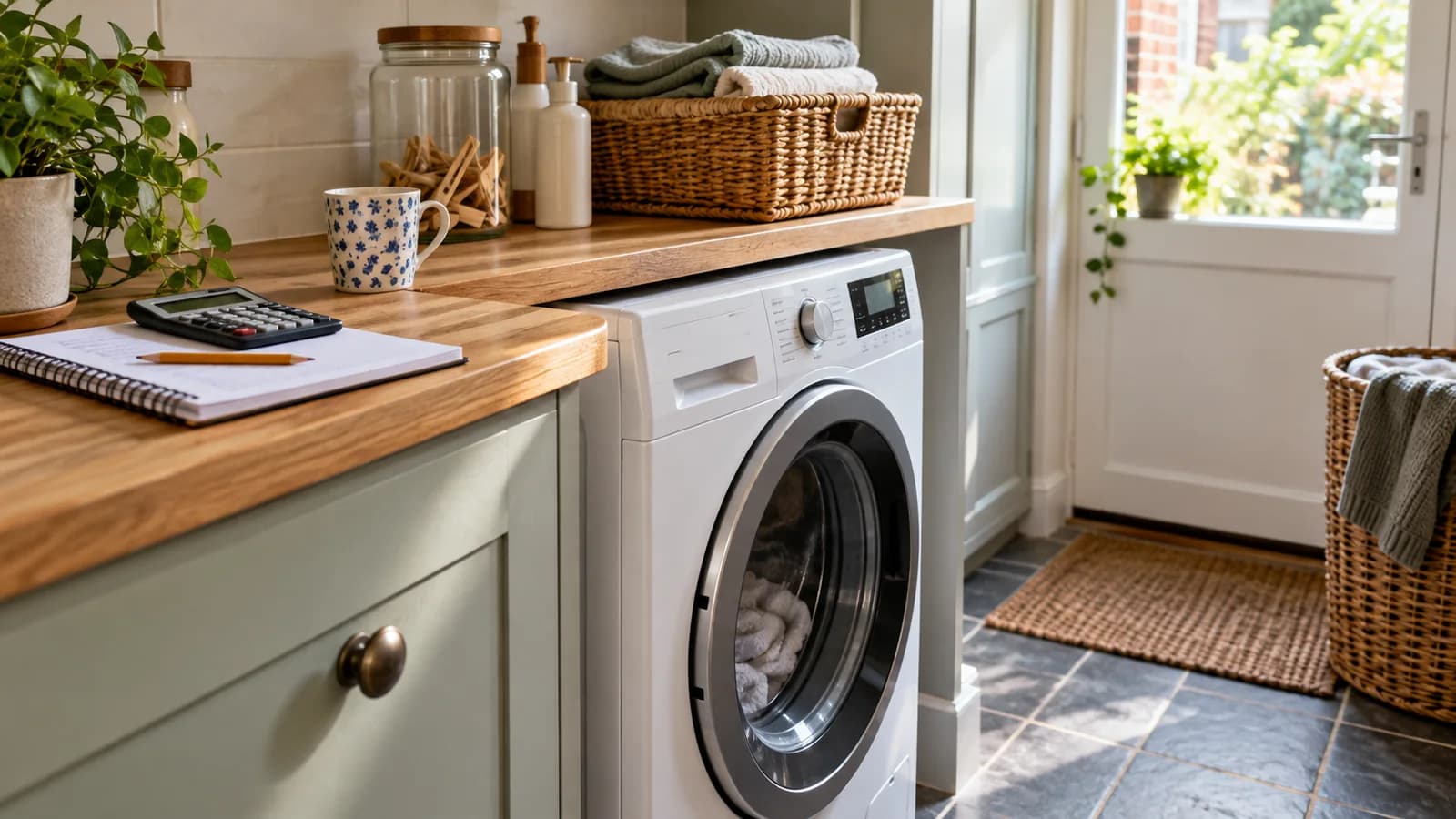
Compare a washing-machine repair quote with the complete replacement cost, then add running-cost differences over the same period. Do not replace a repairable machine merely because a new model has a better energy label. Equally, a low repair quote is not useful if safety, parts availability or recurring faults make the repair unsuitable.
This worksheet supports an ordinary household purchase decision. It is not a fault diagnosis, a current price survey or a prediction of how long either machine will last.
Deal with safety and ownership first
Stop using a machine with suspected electrical damage, burning smells or another serious fault and obtain appropriate help. Electrical Safety First's washing-machine advice includes checking recalls and safe operation. Do not open the casing to gather figures.
If the appliance belongs to a landlord, report the fault and clarify responsibility before commissioning work or buying a replacement. Check warranties, repair cover and any relevant consumer advice separately; this worksheet does not determine legal entitlements.
Collect comparable quotes
For repair, ask what the price covers: diagnosis, call-out, parts, labour, VAT where applicable, repeat visits and any guarantee. Ask what remains uncertain. “Possible pump fault” is not the same offer as an assessed repair with a specified part.
For replacement, include purchase, delivery, installation, required accessories and lawful removal of the old unit. Check dimensions and access. A machine that does not fit the space is not a valid comparison, however attractive the headline price.
Our appliance selection guide helps with broader suitability, including capacity and actual use.
Put both options on the same time horizon
Use these illustrative formulas:
Repair option = repair cost + expected operating cost during the chosen period.
Replace option = installed replacement cost + operating cost during the same period.
Add future repair allowances only as clearly labelled scenarios, not as known facts. Include water costs if they differ materially and you have a relevant metered tariff. Keep finance costs separate and include them if applicable.
Suppose a repair is £150 and a complete replacement is £500. Replacement has a £350 upfront premium. If it saves an illustrative 0.25 kWh per comparable cycle at 25p/kWh, the energy saving is 6.25p per cycle. At 200 cycles annually, that is £12.50 a year. Energy savings alone would take 28 years to recover £350, before other differences. These inputs are examples, not market averages or a lifespan forecast.
Read energy figures correctly
The UK energy-label service documentation identifies washing energy figures in kWh per 100 cycles. Divide that figure by 100 for a label-based per-cycle comparison. Standardised label conditions may differ from your programmes and loads.
For example, a label value of 50 kWh per 100 cycles corresponds to 0.5 kWh per labelled cycle, not 50 kWh each wash. Compare like-for-like test figures; do not compare a washer-dryer's combined wash-and-dry figure with washing alone.
For measurement limitations, see our plug-in monitor guide. Only measure where appliance and monitor instructions permit it.
Test uncertainty rather than hide it
Run three scenarios: repair holds for the chosen period; another paid repair is needed; replacement also incurs an unexpected cost. Keep the assumptions visible. If one option looks preferable only under a very optimistic lifespan, say so.
Consider downtime, laundrette access, repair availability and suitability for your household. Environmental impacts are not captured by electricity cost alone. The Energy Saving Trust maintenance discussion supports extending useful life through care; follow your own machine's maintenance instructions rather than a universal schedule.
Our buy-less framework can help you separate the need for a working appliance from the appeal of an upgrade, while retaining repair safety and suitability as requirements.
Frequently asked questions
Is there a fixed age when replacement becomes better?
No. Condition, diagnosis, parts, use and costs differ.
Should I replace whenever repair exceeds half the purchase price?
That shortcut omits installation, remaining-life uncertainty and suitability. Use complete quotes instead.
Can a better energy rating pay for the machine quickly?
Calculate with realistic consumption and use. A rating improvement alone does not establish a short payback.
What if I cannot get a firm repair quote?
Record the diagnostic charge, likely range and uncertainty. Compare that range rather than inventing a single cost.
Must water savings be included?
Include relevant costs where you can substantiate them. Otherwise label them unquantified rather than assuming zero difference.
Make the decision reviewable
Write down the diagnosis, complete quotes and three uncertainty scenarios. Choose a suitable safe option based on that record. Keep the paperwork so later repairs or replacement decisions can use actual history rather than a remembered headline price.
Grow Here Editorial
Editorial Team
Curating practical, evidence-backed advice for greener homes, sustainable systems, and intentional daily living across Grow Here.
Related Stories
Dehumidifier Running Costs: Calculate Your Actual UK Cost
Use measured kWh and your tariff to compare a complete drying session, including time bands and purchase-cost assumptions.
Letterbox Draught-Proofing: Checks Before Fitting a Brush
Check the source of the draught, door permissions, safe closure and ventilation before choosing a letterbox flap or brush.

Using a Plug-In Energy Monitor in a Rented Flat
Measure suitable plug-in appliances without altering wiring, then turn kWh readings into useful household decisions.