Using a Plug-In Energy Monitor in a Rented Flat
Measure suitable plug-in appliances without altering wiring, then turn kWh readings into useful household decisions.

Grow Here Editorial
Editorial Team
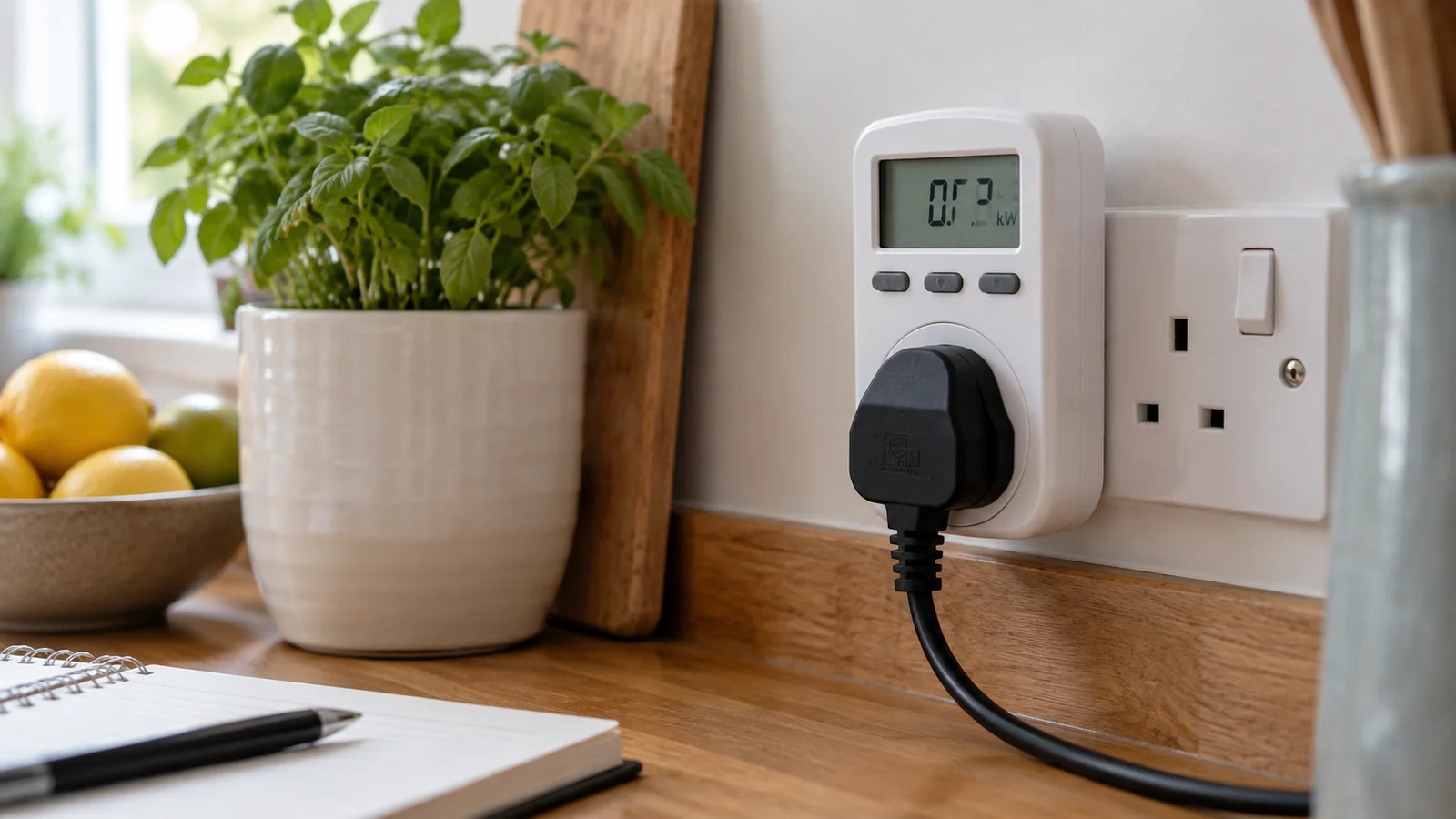
A plug-in energy monitor can measure the electricity used by a compatible appliance without changing the flat's wiring. Check both devices' instructions and ratings first, measure a representative period, and calculate cost from kWh rather than a brief watts reading. It cannot measure a hardwired appliance simply because that appliance uses electricity.
This guide is for ordinary compatible plug-in equipment. Do not open a consumer unit, disturb the electricity meter or fit clamp equipment to unfamiliar wiring as part of this process.
Decide which question you need answered
Useful questions are specific: “How much does this complete programme use?” or “What is this device's normal daily consumption?” An instant reading during one operating phase rarely answers either.
Make a shortlist of two appliances you can access safely. Exclude anything whose connection, rating or instructions make the monitor unsuitable. High-power equipment and appliances with particular installation requirements need extra care; a plug fitting physically is not evidence of compatibility.
The Centre for Sustainable Energy monitoring overview describes monitoring as understanding consumption, including meter readings and bills. Start with the measurement you need rather than buying a device for its own sake.
Check the setup before connecting
Read the monitor's maximum rating, permitted loads, environmental limits and installation instructions. Check the appliance instructions too. Do not use damaged plugs, loose sockets, wet areas or a monitor that crowds another plug into an unsafe position. Avoid extension arrangements unless explicitly suitable under all relevant instructions.
Electrical Safety First provides UK product and socket safety advice. Stop if a connection becomes hot, smells abnormal or shows damage; do not continue collecting data through a suspected fault.
In a furnished rental, confirm who owns and maintains the appliance. Measurement is not permission to repair or replace landlord-owned equipment.
Keep a repeatable record
Write down appliance, model, programme or operating state, load description, start and end time, starting and ending cumulative kWh, and anything unusual. Reset only the intended measurement counter according to the manual.
For a cyclic appliance, use an appropriate representative period rather than multiplying one moment's power by a whole day. For a programme, measure the complete programme. Keep essential appliances operating normally and do not create unsafe conditions to isolate their consumption.
Repeat only when the result is unexpected or the first period was unrepresentative. Our home energy-saving guide helps place the result among other priorities.
Convert the result into cost
Use: electricity cost = measured kWh × unit rate in £/kWh.
Suppose a suitable appliance records 0.8 kWh for one complete use. At an illustrative 25p/kWh, the energy cost is 0.8 × £0.25 = £0.20. If the same use genuinely occurs four times weekly, the illustrative weekly cost is 80p. Neither the rate nor the consumption is a current UK average.
Do not add the daily standing charge to each appliance. Under a time-varying tariff, allocate consumption to the applicable rate periods or label a single-rate calculation as an approximation. See our dehumidifier cost guide for a worked time-band example.
Turn observations into a decision
Compare similar activities, not unrelated watts numbers. A high-power appliance used briefly may consume less total energy than a lower-power one running for hours. Consider whether a proposed reduction changes the service you need, such as clean laundry or safe food storage.
Avoid annual savings claims based on an atypical day. Record a range where usage varies, and compare equipment purchase cost with plausible savings before buying an efficiency upgrade. Our appliance guide offers wider selection considerations.
Frequently asked questions
Can I measure the oven with a plug-in monitor?
Only if the actual connection, ratings and instructions permit it. Many ovens are hardwired and outside this method's scope.
Are watts and kWh interchangeable?
No. Watts describe power at a moment; kWh measures energy over time.
Does a monitor replace the supplier meter?
No. It is a household measurement aid, not the billing meter.
Should I buy a monitor to check one device?
Consider borrowing a suitable one first. Check availability and instructions with the lender.
Why does my cost display disagree with my calculation?
Check the programmed tariff, measurement period, units and whether the device can represent your tariff correctly.
Measure one useful activity
Choose a compatible appliance, record a complete representative use and apply your actual unit rate. Make a change only when the result supports it. Useful monitoring ends with a practical decision, not an ever-growing spreadsheet of readings.
Grow Here Editorial
Editorial Team
Curating practical, evidence-backed advice for greener homes, sustainable systems, and intentional daily living across Grow Here.
Related Stories
Smart Meter Display and Bill Disagree? Check These First
Compare dates, units, tariff information and actual readings before treating an in-home display difference as a billing fault.
Dehumidifier Running Costs: Calculate Your Actual UK Cost
Use measured kWh and your tariff to compare a complete drying session, including time bands and purchase-cost assumptions.
Letterbox Draught-Proofing: Checks Before Fitting a Brush
Check the source of the draught, door permissions, safe closure and ventilation before choosing a letterbox flap or brush.